Burncourt Castle
Burned in 1650 to resist Cromwell, Burncourt Castle still rises with its four walls and twenty-six chimneys in the Tipperary countryside. A sobering historical site with free access, perfect to combine with Cahir or the Rock of Cashel.
Burncourt Castle stands in the countryside of County Tipperary, just a few kilometres from Cahir. This large 17th-century fortified manor house, now in ruins, strikes visitors with its unusual dimensions and twenty-six chimneys still visible on the outer walls. Burned in 1650 to prevent it from falling into Cromwell's hands, it was never rebuilt. Its state of partial preservation offers a powerful testament to the wars that ravaged Ireland in the mid-17th century.
Essential Information at a Glance
- Access: open-air site, accessible from the local road near the village of Burncourt
- Entry: free
- Recommended duration: 20 to 30 minutes
- Attire: sturdy shoes recommended (uneven terrain)
What to See
The ruin preserves its four outer walls in near-intact condition, which is rare for a structure of this era. The twenty-six chimneys — distributed across the façades — bear witness to the original scale of the building. The mullioned windows, partially preserved, give a sense of the architectural style of the Irish fortified manor house of the early 17th century.
History and Context
Burncourt Castle was built around 1641 for Sir Richard Everard. Barely completed, it was burned in 1650 by its owner, Lady Everard, to prevent Cromwellian forces from occupying it. This episode illustrates the brutality of Cromwell's military campaign in Ireland, which destroyed or confiscated many Catholic residences throughout the country.
Highlights of Your Visit
The Chimneys on the Façade
Twenty-six chimney stacks still crown the walls. This architectural detail, exceptional for an Irish ruin, allows visitors to imagine the original interior richness of the building.
The Outer Walls
The height and integrity of the four walls are remarkable. From the outside, the rectangular plan and proportions of a great manor house are clearly visible.
Photography Tips
Late-afternoon light accentuates the texture of the stone and shadows of the mullioned windows. An angle from the south-west corner allows you to frame both main façades with the chimneys in silhouette. The site is open: no major vegetation obstructs the walls.
Location and Access
Burncourt Castle is located in the village of Burncourt, in southern County Tipperary. The site is accessible by car from Cahir, approximately 10 km to the north-east. No regular public transport serves the village directly. Parking is available on the local road immediately adjacent to the site.
Nearby Attractions
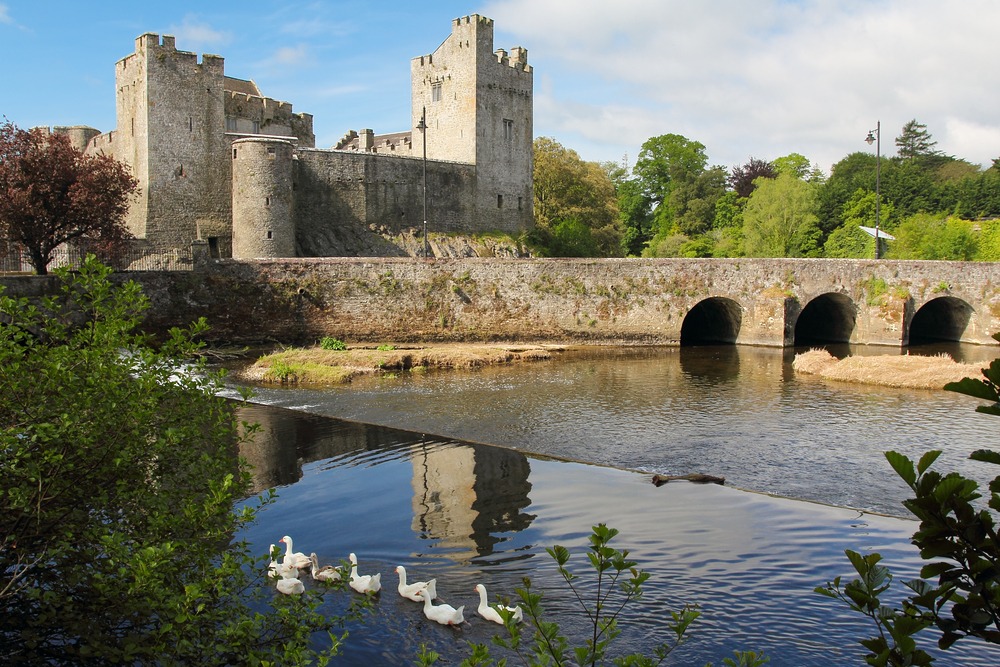
- Cahir Castle — one of Ireland's best-preserved medieval castles, about ten kilometres away.
- Rock of Cashel — ensemble of medieval ruins on a rocky outcrop, approximately 25 km to the north.
- Galtee Mountains — nearby mountain range, ideal for hiking.
Frequently asked questions
No, the site is free to access.
The outer walls are accessible from the outside. The interior is open but the ground is uneven; sturdy shoes are recommended.
About twenty minutes is sufficient to walk around the site and observe the architectural details.
Yes. Cahir Castle and the Rock of Cashel are easily visited in the same day by car.
No known restrictions. The site is in the open air and photography is free.
Interested in this visit?
We can include it in your personalised itinerary.